To get better at speaking on camera, there is no more effective method than recording yourself, watching yourself back and trying again. Video self-observation helps you identify and correct what no outside advice can show quite as clearly: your pace, eye contact, mannerisms and posture. Add a specific goal for each take, feedback (your own, a peer’s or AI-generated) and spaced practice, and you can make rapid progress.
Speaking on camera feels intimidating for almost everyone at first. The good news is that it is a skill, not a gift, and cognitive science tells us exactly how to develop it.
Why seeing yourself on screen changes everything
This mechanism has a name: video self-modelling. Watching yourself perform a task activates a cycle described by psychologist Albert Bandura: you observe yourself, assess yourself and then adjust your behaviour. Several studies show that seeing yourself succeed strengthens both self-confidence (your sense of self-efficacy) and actual performance.
The reason is simple: from the inside, you cannot perceive what your audience sees. You think you are speaking calmly when you are actually rushing, or looking into the camera when your eyes are wandering. Video makes this gap visible, and once you spot something in yourself, you can correct it. One useful nuance, supported by research: the effect is stronger when self-observation is repeated and backed up by practice, rather than done just once.
What research says about video feedback
Recording yourself is not enough: feedback is what drives improvement. A meta-analysis published in Educational Psychology Review (Fukkink et al., 2011) showed that video feedback has a significant positive effect on professionals’ interaction and communication skills. Several studies on public speaking confirm that listening to yourself, assessing your performance and trying again improves fluency, ease and confidence.
This is the principle of deliberate practice: you do not improve by repeating blindly, but by practising with a clear goal and immediate feedback on how far you are from achieving it. Video provides the most honest mirror for this.
A method for improving your on-camera speaking skills
Mistakes that undermine your on-camera delivery
Where to practise without pressure
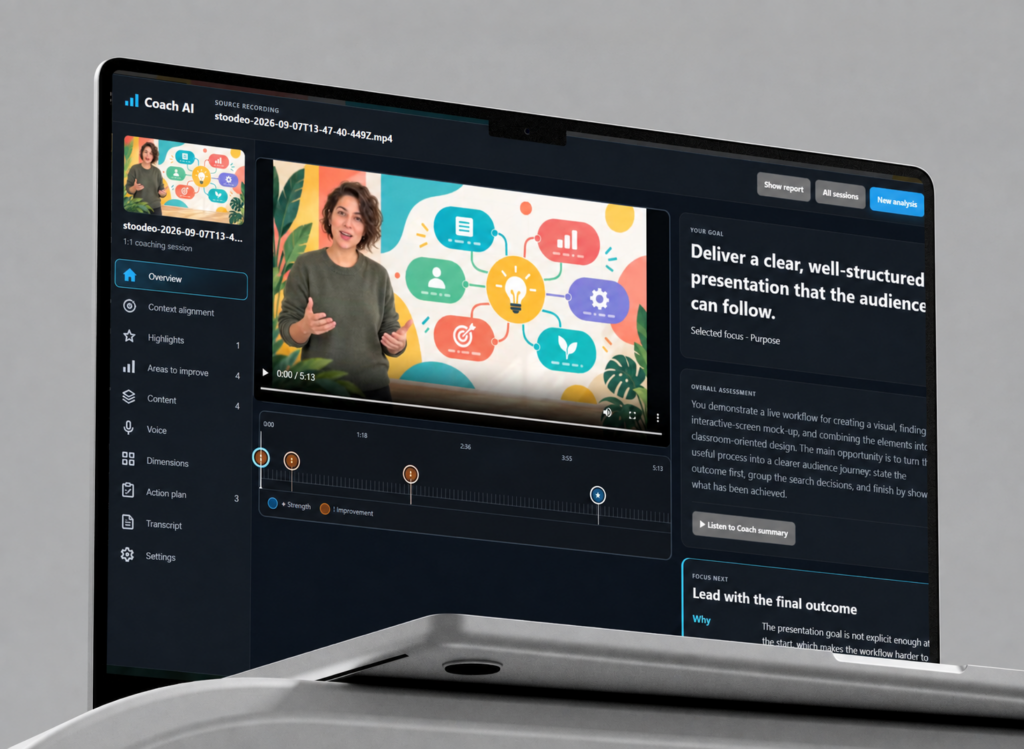
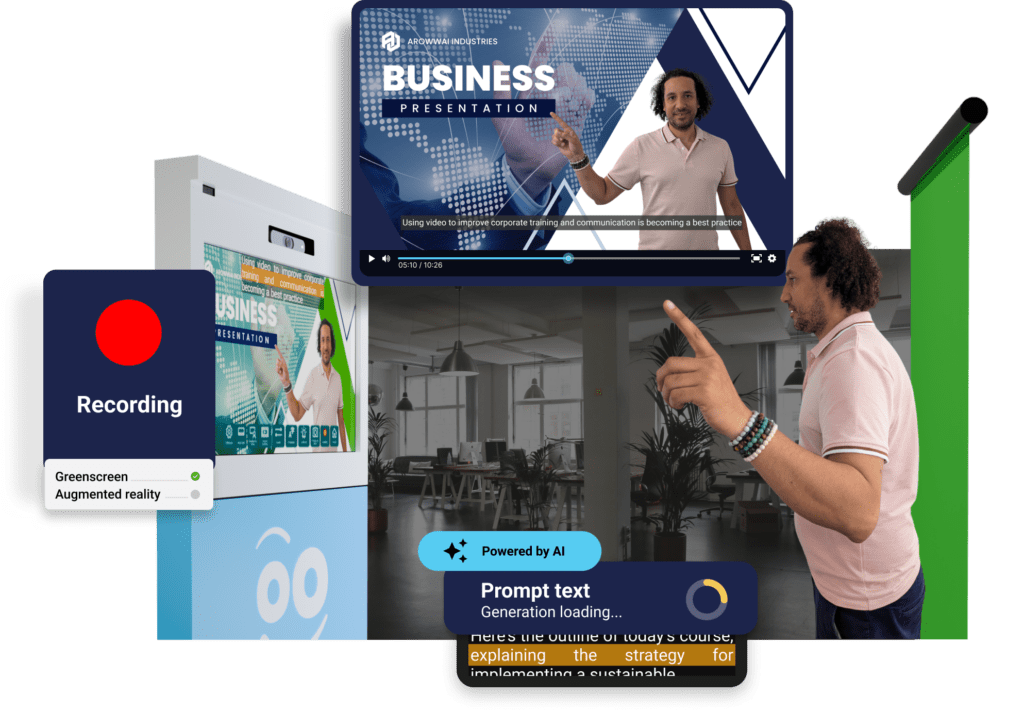
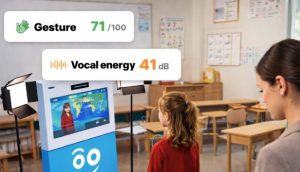
This is exactly what a Rapidmooc studio or Stoodeo software lets you do: record yourself, watch yourself back and try again as often as you like, without equipment or editing. The teleprompter guides you while keeping your delivery natural, chroma key places you in a setting where you feel at ease, and you can re-record at the touch of a button until you get the right take. Some systems even offer an AI coach that analyses your delivery and provides objective feedback — precisely the kind of feedback that research identifies as a driver of progress. The aim is not to replace you with an avatar, but to give you the mirror and repeated practice you need to improve.
Summary
Speaking well on camera is not about talent, but a simple cycle: one goal, one take, feedback and another take, repeated over spaced sessions. Watching yourself in action provides the most honest and effective feedback. Record yourself, review your performance honestly but kindly, and try again: that is how you become comfortable on camera.