Training videos are now a cornerstone of learning strategies. They support onboarding, compliance, knowledge transfer, and upskilling at scale. Yet despite better tools and lower technical barriers, many L&D teams face the same issue: training video production does not scale as expected.
The bottleneck is no longer technology. It is production efficiency and more specifically, the ability to record clear, usable videos quickly and consistently. As video capture becomes accessible to everyone, scalability increasingly depends on one overlooked factor: speaking efficiency.
The real scalability problem in training video production
Most training video initiatives struggle for the same reasons:
recording sessions take too long
videos require multiple retakes
quality varies from one presenter to another
trainers and SMEs need constant support
These issues are rarely caused by the recording tools themselves. They are caused by uncertainty at the moment of speaking: unclear delivery, inconsistent pacing, hesitation, and lack of structure.
When speaking is inefficient, video production slows down. When it slows down, scaling becomes impossible.
Why speaking skills are now a productivity lever
In a scalable learning model, training videos must be:
quick to produce
easy to repeat
consistent in quality
measurable over time
Speaking skills directly affect all four dimensions.
A presenter who speaks clearly, at a steady pace, with confidence and structure:
In this context, speaking skills are no longer just a soft skill. They become a core operational lever for scaling training video production.
From complex recording to efficient video workflows
Another key shift is happening across L&D organizations: recording itself is no longer the problem.
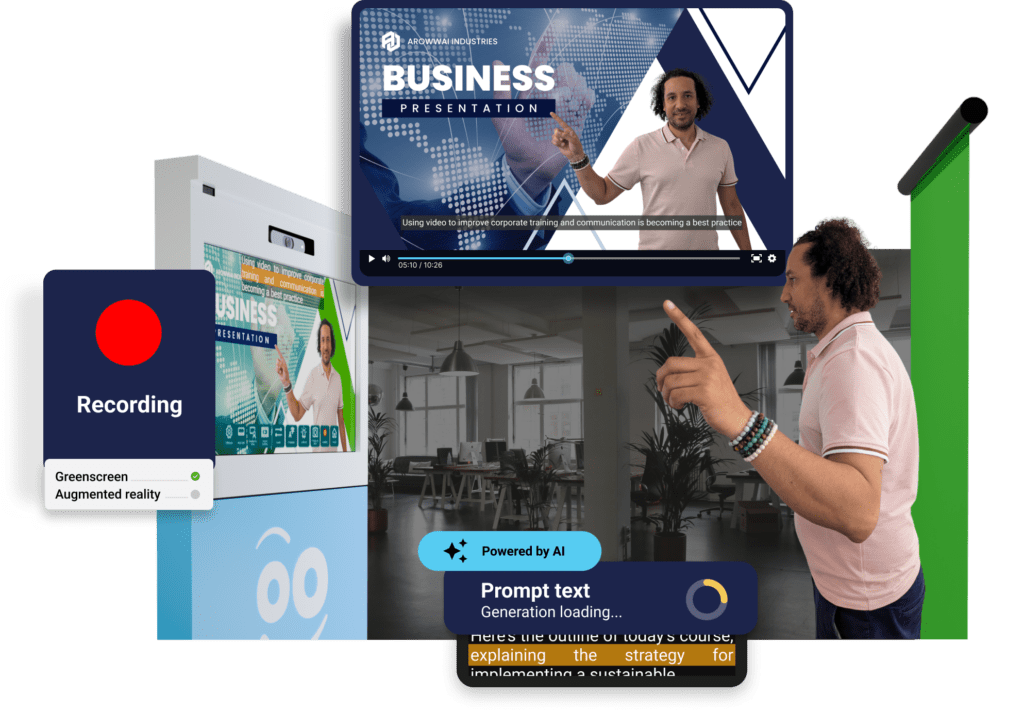
Modern video studios designed for learning, such as Rapidmooc, allow trainers, SMEs, and educators to record professional-quality videos without technical skills. Recording becomes fast, repeatable, and predictable.
This changes the equation:
👉 Discover how simplified video recording accelerates training production with Rapidmooc.
Once technical friction is removed, speaking efficiency becomes the main variable impacting scalability.
AI and metrics: making speaking efficiency measurable
Efficiency cannot scale without measurement. This is where AI plays a decisive role.
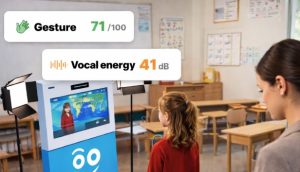
When an AI Coach is embedded directly into the video workflow, it introduces objective indicators that support faster production:
speaking pace
flow and consistency
clarity of delivery
These metrics create a shared reference point for presenters, trainers, and L&D teams. Instead of relying on subjective feedback or trial-and-error, teams gain measurable signals that help standardize production quality.
👉 Learn how the AI coaching with Rapidmooc supports speaking efficiency and production consistency.
The result is fewer retakes, shorter recording sessions, and more predictable outcomes.
Scaling production without increasing trainer workload
One of the main obstacles to scaling training videos is trainer availability. Every inefficient recording session consumes time… reviewing, correcting, re-recording.
By combining:
simplified recording environments
AI-supported speaking metrics
standardized video formats
L&D teams can significantly reduce the time spent per video.
Trainers shift from constant supervision to targeted intervention, focusing on content quality and learning design rather than delivery mechanics. This allows production volume to grow without increasing workload proportionally.
Proven scalability in large organizations
From isolated videos to scalable learning series
Scalability also requires a shift in format. One-off training videos are difficult to maintain and update. Efficient production makes it possible to design learning series instead : short, repeatable videos recorded regularly.
This approach:
reduces pressure on each recording
improves content refresh cycles
increases learner engagement
aligns naturally with measurable speaking metrics
👉 Learn how to turn a course into a scalable video learning series.
Scaling training videos through efficiency, not shortcuts
Scaling training videos does not mean lowering expectations or cutting corners. It means removing friction from production and making speaking efficiency measurable.
When speaking skills are supported by AI, metrics, and efficient recording environments, training video production becomes:
faster
more consistent
easier to repeat
truly scalable
Today, the organizations that scale learning successfully will not be those producing more videos but those producing them more efficiently.