Skills are evolving faster than ever. Learning & Development teams are under constant pressure to train more people, more frequently, across a growing range of topics, while keeping content relevant, engaging, and scalable.
In this context, three forces are reshaping modern learning strategies:
1. Video, now the preferred learning format ;
2. Artificial intelligence, accelerating and enhancing content creation ;
3. Autonomy, enabling learning teams to scale production without scaling complexity.
Together, these three pillars define what is increasingly referred to as augmented learning: a model where technology amplifies human expertise rather than replacing it.
Video has become the language of learning
The data is clear: the massive enthusiasm for video is not slowing down anytime soon. Nearly two-thirds of employees prefer learning through video (Source: Wyzowl, 2023).
Why such widespread adoption?
Because video combines engagement, clarity, retention, and speed. It meets today’s expectations perfectly: short, visual, and accessible anywhere, anytime.
For L&D leaders, video is no longer a “nice to have”, it’s a core pillar : Onboarding, operational know-how, tutorials, safety, leadership, internal communication, change management… everything now runs through video.
The main challenge ? Producing more videos, faster. Demand keeps growing, while production capacity remains limited.
Demand is exploding, but production capacity isn’t scaling at the same pace.
This gap has become a strategic bottleneck: L&D teams need volume, but organizations are still set up to produce video the “old way.”
Autonomy: the lever that changes everything for learning teams
1. The autonomous studio model
All-in-one video studios now allow any subject-matter expert to:
This self-service approach fundamentally transforms video production. Direct benefits for L&D teams include:
2. Autonomy as a lever for scale
An autonomous studio made it possible to produce:
Without autonomy, achieving this level of volume would have required much larger L&D teams and a significantly higher budget.
Other common use cases observed across organizations include:
Video autonomy becomes a true pedagogical orchestration tool.
AI: the accelerator of augmented learning
One of the biggest barriers for subject-matter experts is preparation: writing a script, structuring the message, finding the right tone. This is exactly where AI becomes decisive.
1. AI to prepare faster and better
The result: experts arrive prepared, confident, and ready to record.
2. AI to analyze and improve video performance
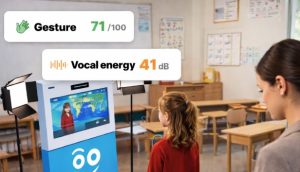
The Rapidmooc AI Coach provides immediate feedback on:
This neutral, objective guidance creates a virtuous loop:
-
I prepare,
-
I record,
-
I get a feedback,
-
I improve,
-
I keep going.
This loop is a strong indicator of augmented learning.
Best practices for L&D teams to anchor video autonomy
Organizations that successfully adopt autonomous video share five key elements:
1. A clear framework and simple governance
2. Short, hands-on training
A focused workshop (often around 90 minutes) is usually enough to ensure adoption.
3. Empathetic, human support
4. Short formats to maximize impact
Neuroscience : 2 to 6 minutes to maintain attention.
Large-scale use cases: video capsules of 2 to 3 minutes
5. A ready-to-use toolbox
These elements significantly accelerate adoption among subject-matter experts.
Summary
Problem = video demand > production capacity
Solution
Video autonomy + AI
Benefits
scalability, quality, speed, engagement
Examples
large-scale production, rapid adoption, expert upskilling
Outcome
A organization where video becomes a natural language and where AI amplifies the ability to produce and share knowledge.
Conclusion
The combination of Video + AI + Autonomy is redefining learning strategies.
AI makes it possible to:
Augmented learning is no longer a distant vision: it’s an operational approach that is accessible and ready to be deployed in any organization.