Oral skills as a collective process...
By combining play, performance, and speech analysis, oral expression stops being a one-off classroom exercise.
It becomes a shared learning process but also a highly individual journey.
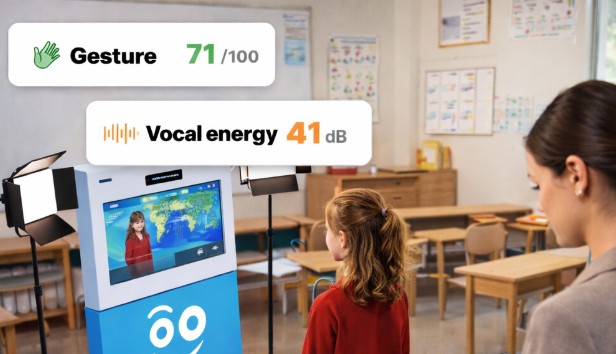
On a collective level, working with video and speech metrics creates a common language around oral expression.
Students are no longer compared to each other.
They are compared to clear, shared objectives:
Because everyone works within the same framework, oral practice feels safer.
Speaking is no longer a spotlight moment, it’s a normal, repeated activity embedded in the learning process.
At the same time, progress in oral expression remains deeply personal.
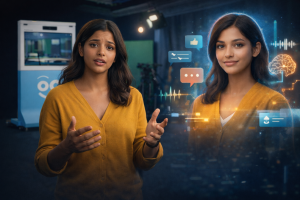
Thanks to autonomous video recording environments like the Rapidmooc studio, students can:
...and a personal journey
At the same time, progress in oral expression remains deeply personal.
Thanks to autonomous video recording environments like the Rapidmooc studio, students can:
This autonomy is critical.
It allows students to decouple practice from exposure.
A learner can rehearse multiple times, observe their own progression, and arrive in front of the group already more confident, not because they were pushed, but because they were prepared.
Speech metrics support this individual path by offering objective reference points, not judgments.
They help students understand how they are evolving, even when the progress feels invisible.
Collective culture, individual mastery
This is where the real strength of the approach lies.
The classroom benefits from a shared structure and vocabulary around oral expression.
Each student benefits from a private, self-paced training space.
Collective culture and individual mastery are not in opposition — they reinforce each other.
Oral expression becomes:
collective, because everyone practices within the same framework
individual, because everyone improves at their own pace
🔗 To see how this balance between autonomy and collective learning is enabled through video and speech analysis, the Coach IA page details the core principles behind the approach.
When oral expression becomes a learning game, everything shifts.
Students gain confidence through performance, repetition, and autonomy.
Teachers guide progress using clear, objective metrics.
Together, they turn speaking into a continuous, collaborative learning process rather than a one-off evaluation.
Technology doesn’t replace pedagogy, it supports it.
By combining autonomous practice with shared reference points, oral skills become trainable, inclusive, and accessible to all.
About Rapidmooc
Rapidmooc designs autonomous video studios that make it easy to create, analyze, and improve video-based learning and communication.
With 800+ studios deployed in over 40 countries, Rapidmooc supports educators, trainers, and organizations worldwide in making oral expression a natural, scalable skill.