Embodying your message in the age of AI: The real speaking challenge of 2026
#speakingskills #AI #embodiment
Table of contents
Table of contents
Rapidmooc in Education
Discover how schools, secondary schools, high schools and colleges transform their learning experience with Rapidmooc
Similar articles
Today, the question is no longer “Should we produce more videos?”
That debate is over. Organizations are producing content.
A lot of it. Faster than ever.
The real emerging pain point lies elsewhere:
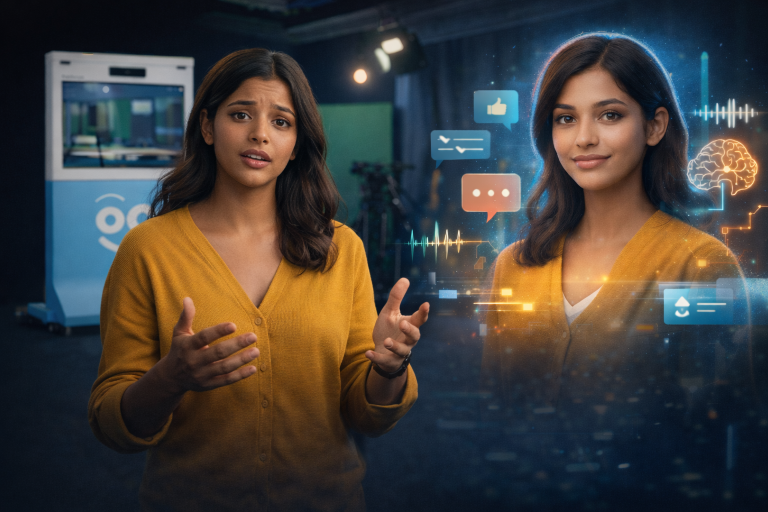
How do you still embody your message when video production becomes industrialized, and partially automated by AI?
The AI paradox: more videos, less embodiment
AI has delivered on its promises. Scripts generated in seconds. Realistic avatars. Smooth synthetic voices. Instant subtitles. Video production has never been so accessible.
And yet, across L&D, training, and internal communication teams, the same feedback keeps coming up:
- videos are technically flawless
- messages are clear
- but engagement and retention are dropping
Why?
Because embodiment can’t be automated.
The rise of AI-assisted content has created a new kind of fatigue: too polished, too neutral, too detached.
Learners and employees are no longer just looking for information, they’re looking for:
- a real voice, with its imperfections
- a clear but spontaneous posture
- a credible human presence
Embodiment is not about “being comfortable on camera”
Another misconception fading : embodiment ≠ improvisation.
The most common blockers aren’t technical, they’re human:
- tone that feels flat or forced
- stiff posture
- wandering eye contact
- accurate content...with no impact
Many subject-matter experts still hesitate to record on their own.
Not because they lack skills but because they lack real-time, supportive feedback.
The new key need: guidance without losing control
This is where AI’s role is evolving. Right now, the most valuable AI isn’t the one that replaces humans :
it’s the one that helps them express themselves better.
We no longer expect AI to “do it for us”, but to:
- reassure
- structure
- fine-tune
- encourage
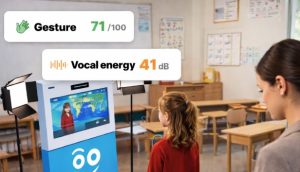
A subtle AI coach, embedded directly into the recording experience, able to:
- suggest more natural phrasing based on a real recording
- flag a monotonous rhythm directly from your speech
- gives instant feedback on a take in real-time
- help align message, posture, and communicating objective
Reconnecting autonomy with embodiment
True video maturity isn’t full automation.
It’s the balance between:
- production autonomy
- pedagogical quality
- strong human presence
The organizations that succeed are those that allow experts to remain visible, identifiable, and credible, while using intelligent tools to remove friction.
Technology becomes an expression enabler, not a mask.
And AI becomes a speaking ally, not a substitute.
From expression to impact
Embodying a message can’t be automated.
But it can be supported, guided, and strengthened.
That’s exactly where the role of AI becomes meaningful, not as a substitute for the speaker, but as a coach embedded in the moment of creation. One that helps refine delivery, adjust rhythm, clarify intent, and build confidence, without breaking autonomy or authenticity.
This is the philosophy behind the Rapidmooc AI Coach:
an integrated assistant designed to support on-camera expression in real time, within the recording experience itself. No technical barrier. No external feedback loop. Just subtle guidance to help speakers show up more clearly, more naturally, and more effectively.
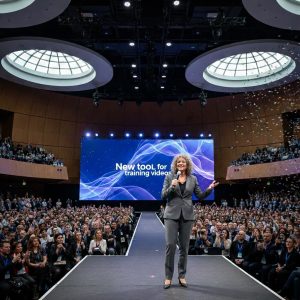
In a world where AI makes video production faster than ever, the real differentiator is no longer speed, it’s presence.
With the right tool, presence becomes your strongest advantage.