AI accelerates, humans structure: the new pedagogical equation
#augmentedpedagogy #AI #education
Table of contents
Table of contents
Rapidmooc in Education
Discover how schools, secondary schools, high schools and colleges transform their learning experience with Rapidmooc
Similar articles
Since the arrival of generative AI, teachers, trainers and students have discovered new ways to approach learning. And while tools evolve fast, the underlying challenges remain surprisingly stable: learning how to search, reason, verify, express oneself. In other words: learning to think as an actor, not a follower.
Emerging pedagogical practices clearly reflect this shift.
Exploration via trial-and-error: the first learning ground
Today, many teachers use AI as a field for exploration. In some classrooms, for example in Polynesia, sessions begin with spontaneous prompts sent to the AI before any theoretical lesson on a given topic.
Students fumble, test, compare. The goal is not the “right answer,” but to reveal their thinking process.
The teacher then observes:
- how students formulate their queries,
- their reasoning biaises,
- the connections they make (or fail to make).
Then comes a group reflection : prompts are reviewed, their logic and structure dissected… a true education to thinking emerges.
This approach illustrates a broader movement: AI becomes a cognitive mirror, reflecting what the user thinks, knows, or believes he knows.
Explicit reasoning : documenting to better understand
Another widespread use, supported by institutional initiatives, consists in asking students to make their reasoning visible.
This can take various forms :
- a digital logbook,
- an annotated draft,
- a screenshot of their AI conversation,
- or a short recording where the student explains why they chose this prompt, what strategy they used, which adjustments they made during the exchange.
This last format, easily done by smartphone, tablet or a simple video station, has a major advantage: verbalization forces you to structure your thoughts. You can’t explain without clarifying; you can’t clarify without understanding.
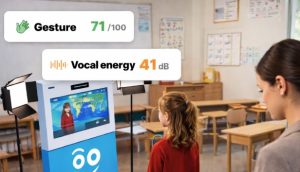
In this logic, some institutions use a simple video setup : not to “make a video,” but to allow learners to document their reasoning, visualize progress, practice oral expression, and observe the impact of their lexical or logical choices.
Verify, compare, critique : the core of the AI phenomenon
As many educational experts point out, AI does not validate truth: it pre-produces text based on its training, whose sources are not necessarily controlled by teachers.
That’s why simple pedagogical rituals are essential :
- compare two AI responses obtained with different prompts,
- identify "hallucinations", inaccuracies, cultural or contextual biaises,
- detect what originates in user input, not in the model itself,
- confront the AI’s answers with reliable sources: textbooks, verified research, scientific resources
Such practices build the core skills of what could be called “accelerated learning with AI”: skepticism, verification, comparison, and reasoning prioritization.
Concrete practices transforming classrooms
Whatever the discipline, similar practices are emerging :
- Send a naive prompt about a phenomenon
- Analyze errors in the AI's answer
- Reformulate the prompt for more precision
- Compare a “generic” AI answer versus a “guided” one, to understand how context affects narrative framing.
- Rewrite a paragraph while justifying each choice.
- Ask the AI to correct a dialogue… then analyze why it made those corrections.
- Record a short presentation in the target language to work on tone and coherence.
- Study AI biases regarding culture, geopolitics or representation.
- Produce a video capsule explaining a complex reasoning : debates, arguments, nuance.
In many institutions, video plays a key role: it forces choice, structure and ownership of one’s reasoning.
Especially when recordings can be replayed, compared, improved, autonomously and as often as needed.
A guiding principle: build capacity to think, express, verify
As many observers note, the goal is not to replace traditional practices with AI, but to reinforce human skills:
- judgment,
- argumentation,
- analysis,
- reformulation,
- presentation,
- synthesis.
In other words : AI becomes a training ground, not a shortcut.
And video, even simple, becomes a tool to consolidate one of the most transversal skills today: structured orality, the ability to make visible and audible the construction of ideas.
In the age of AI, practice matters more than tools
There’s a lot of talk about technologies.
But in the uses observed on the ground, what transforms learning isn’t the tool, it’s the practice.
AI acts as a catalyst.
Video becomes an amplifier of thought.
Teachers remain the architects of this evolution.
So the key isn’t the tool or the platform :
👉 it’s how we structure, document, and share thinking.
Keep reading...

When the studio becomes intelligent: the role of the AI Coach in video-Based speaking skills
Read More »