We don’t remember what we see. We remember what we do.
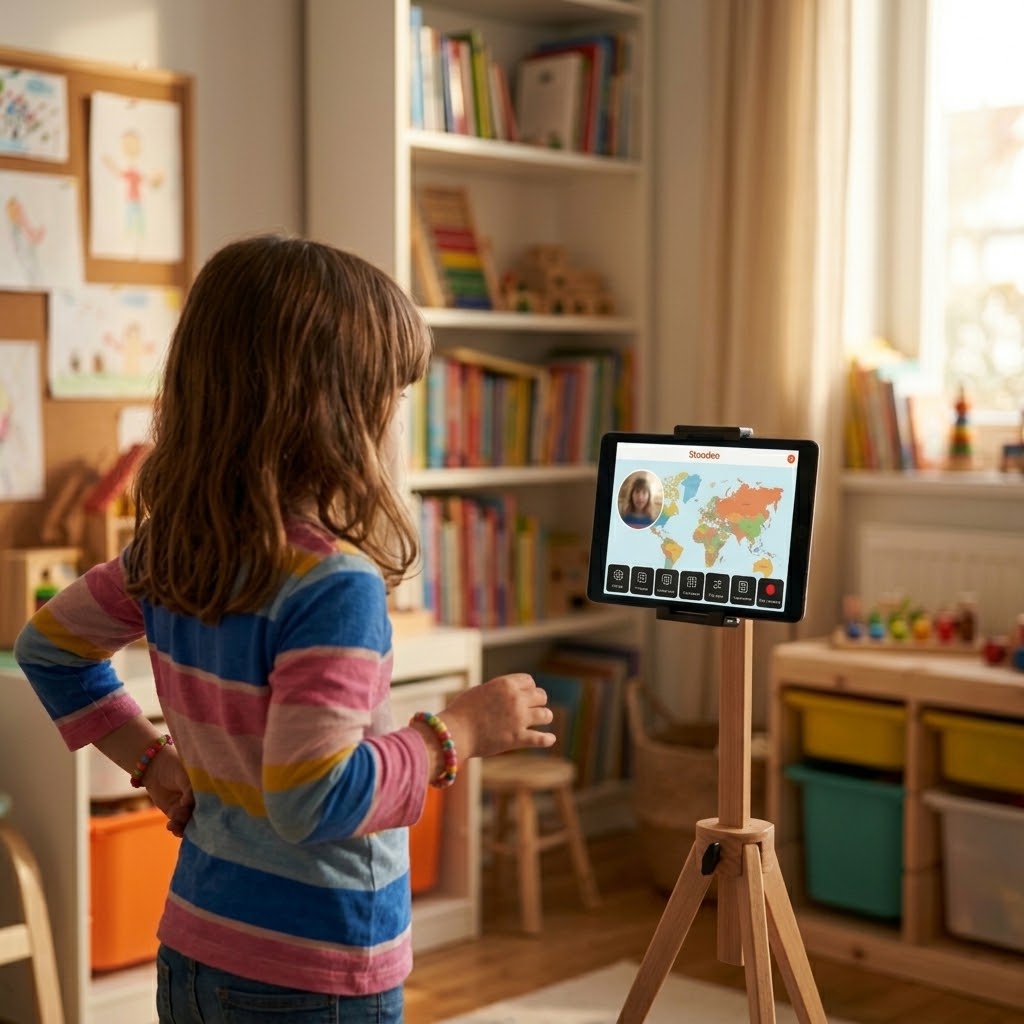
Table of contents
A good story captivates you. You watch it all the way through; you’re hooked. Telling a story was already a way to capture people’s attention. But let’s be honest: a few days later, what’s left of it?
Watching—even when captivated—is still just watching from the outside. And what we observe from a distance fades away. What stays with us is what we’ve experienced from the inside: a situation we’ve gone through, a gesture we’ve seen ourselves make, a response we’ve given ourselves. The video that educates isn’t the one we watch. It’s the one we step into.
This is Stoodeo’s second superpower: it doesn’t place the learner in front of the content, but right inside it.
We learn by living, not by being taught
Our memory is lazy when it comes to what it receives, but generous with what it experiences. Two well-documented mechanisms explain this. When we have to come up with an answer ourselves instead of reading it, we remember it much better: this is the generation effect. And when we search our minds for information in order to act, we commit it to memory, rather than simply rereading it: this is active retrieval.
Translation: A video that simply shows things clearly informs. A video that draws you in, gets you to act, and lets you see yourself doing so educates. The first fills your mind for a moment. The second leaves a lasting impression.
Be part of the content, not in front of it
The big shift with Stoodeo is the person’s place. They aren’t filmed in front of a wall; they’re embedded in the scene: on the map, in the diagram, next to the object, at the heart of the situation. They’re no longer in front of the subject—they’re in the subject. And from the inside, you don’t just endure—you take action.
For the learner, this shift changes everything. It takes three forms, and each one provides a foundation in its own way.
- To have it done to oneself. L'apprenant se filme en train d'expliquer, de refaire le geste, de dérouler le cas. Il se revoit, et se voir agir est l'un des moteurs de progression les plus puissants qui soient, à l'oral comme dans le geste : on corrige ce qu'on observe chez soi.
- Interact with the content. Immersed in the scene, he doesn't comment from a distance. He points out, highlights, connects, and manipulates elements right on the screen. His hand is right in the thick of things, not on the sidelines.
- Experience the situation. Placed at the center of a scenario, he doesn't just observe a situation—he lives through it. He reacts, demonstrates, and makes decisions, as if it were real. And what we've experienced, we know how to do again.
He no longer simply receives knowledge. He experiences it. And the learner who experiences it becomes, in his own way, a teacher: we learn remarkably well by showing what we can do.
In practice: the same video, first as a passive viewer and then as an active participant
Let’s consider a situation that is familiar to many professions: learning to stay in control during a tense moment when dealing with a client, a patient, a service user, or a coworker.
Passive form. Vous expliquez la bonne attitude. Rester calme, écouter, reformuler, désamorcer. C’est juste, c’est clair. L’apprenant acquiesce, ferme la vidéo, et le jour où la tension monte pour de vrai, il retombe dans ses réflexes. Il a vu comment faire, il ne s’est jamais vu le faire.
Real-life version. You put him in the scene. There he is, right in the middle of the situation, in the place of the person who has to respond to the irritated person on the other end. He acts out his reaction; he lives it. Then he watches himself: he spots the moment on screen when his tone slipped, he highlights what he could have done differently, and he re-enacts it. He didn’t just watch a lesson on managing tension. He went through one, saw himself go through it, and corrected himself by watching himself. That’s what sticks.
Same content, same duration. But one demonstrates expertise, while the other lets you experience it.
Stoodeo gets you up to speed on the topic
That’s where the app really comes into its own. A Stoodeo video isn’t just a screen you watch—it’s a space you step into.
Immersion places you inside the setting, the scene, the diagram: you’re inside it, not in front of it. From there, you interact with the content, display it, annotate it, and manipulate it. And you see yourself doing it, which helps you make progress. When you hand it over, the learner inherits all of this: they step in, take action, see themselves, and experience the subject from the inside.
Your learners aren’t just watching a video anymore. They’re right in the middle of it. And what we’ve experienced, we remember.
And that goes for all professions
No matter where you want it to stay, accessing the content changes everything.
- In training, a hands-on simulation experienced from the inside reinforces skills better than ten slide presentations viewed from a distance.
- During onboarding, a new hire who takes the initiative to integrate into the team is actively shaping their role rather than passively accepting it.
- When it comes to a movement or a procedure, watching yourself perform it and then correcting yourself as you watch transforms the demonstration into a skill.
- When it comes to public speaking and soft skills, watching yourself in action is the most honest feedback you can get—and the most effective way to improve.
Knowledge remains yours. Bringing it to life from within is what transforms it from something understood into something truly learned.
Let them in
Take an explanation you often share. Find the moment when, instead of going through it from start to finish, you could draw the other person into the scene. Open Stoodeo, create that moment where they experience the content rather than just watching it, and post it.
You’ll see the difference in people’s faces: they won’t just be looking at you anymore—they’ll be right there with you, right in the thick of it.
Stoodeo is free for your first video.